









Understanding Engine Oil: What Every Driver Should Know
This guide explains everything Kenyan motorists need to know about engine oil, including its purpose, oil grades, service intervals, and how to choose the right oil for your vehicle.

CN Quick Facts
- Engine oil lubricates moving engine components, reducing friction, wear, and heat.
- Clean engine oil improves fuel economy, performance, and engine lifespan.
- Kenya’s driving conditions, such as traffic congestion, dust, high temperatures, and long-distance travel, create additional demands on engine oil.
- Regular oil changes are one of the most affordable ways to prevent costly engine repairs.
Essential Information for Every Driver
Engine oil is one of the most important fluids in your vehicle, yet it is often one of the least understood by motorists. Many drivers know they need to change their oil periodically, but few understand what engine oil actually does, why different oils exist, or how using the wrong oil can affect their vehicle.
What's in this Article
- Essential Information for Every Driver
- What Is Engine Oil?
- What Does Engine Oil Actually Do?
- What Happens If You Don’t Change Engine Oil?
- What Do Oil Grades Mean?
- What Is the Difference Between Mineral, Semi-Synthetic, and Fully Synthetic Oil?
- How Often Should You Change Engine Oil?
- Why Do Kenyan Driving Conditions Matter?
- How Do You Check Engine Oil?
- What Are the Signs Your Engine Oil Needs Attention?
- What Is an Oil Filter and Why Is It Important?
- Can You Use Any Engine Oil?
- Conclusion
Whether you drive a Toyota Vitz, Mazda CX-5, Nissan X-Trail, Isuzu D-Max, or Toyota Land Cruiser Prado, engine oil plays a vital role in protecting your engine and ensuring it performs efficiently. In Kenya, where vehicles regularly encounter heavy traffic, dusty roads, high temperatures, and long-distance travel, proper engine lubrication is even more critical.
This guide explains everything Kenyan motorists need to know about engine oil, including its purpose, oil grades, service intervals, and how to choose the right oil for your vehicle.
What Is Engine Oil?
Engine oil is a specially formulated lubricant designed to protect the internal components of an engine. As an engine runs, hundreds of moving parts operate at extremely high speeds and temperatures. Without proper lubrication, these components would quickly wear out due to friction and heat.
Engine oil creates a protective layer between moving metal surfaces, allowing them to operate smoothly while reducing wear and preventing damage.
What Does Engine Oil Actually Do?
Many motorists think engine oil simply “lubricates the engine.” While true, modern engine oil performs several important functions.
- Lubrication: The primary function of engine oil is to reduce friction between moving parts such as pistons, the crankshaft, camshaft, valves, and bearings. By minimising friction, the oil contributes to less wear and extends the lifespan of the engine.
- Cooling: Engine oil helps remove heat from critical engine components. Although the cooling system handles most engine temperature control, oil plays an important supporting role in preventing overheating.
- Cleaning: Modern oils contain detergents and additives that help remove carbon deposits, dirt, sludge, and combustion by-products. These contaminants are then captured by the oil filter.
- Corrosion Protection: Engine oil protects metal components from moisture and corrosion. This is particularly important for vehicles that are not driven regularly.
- Sealing: Oil helps create a seal between pistons and cylinder walls, improving engine efficiency and compression.
What Happens If You Don’t Change Engine Oil?
Over time, engine oil degrades.
As it ages, oil becomes contaminated with:
- Dirt
- Fuel residues
- Carbon deposits
- Moisture
- Metal particles
Eventually, it loses its ability to lubricate effectively.
This can lead to:
- Increased engine wear
- Poor fuel economy
- Reduced performance
- Overheating
- Engine sludge build-up
- Costly engine damage
An oil change costing a few thousand shillings can prevent engine repairs costing hundreds of thousands of shillings.
CN Expert Insight
A common misconception is that:
❌ “Diesel engines use 10W-40 and petrol engines use 5W-30.”
In reality, engine oil should always match the manufacturer’s specification found in the owner’s manual. Many modern diesel engines, including those found in BMW, Mercedes-Benz, Volkswagen, Toyota, and Mazda models, now use 5W-30 or 5W-40 oils.
Using the wrong oil can lead to:
- Reduced fuel economy
- Increased engine wear
- Turbocharger damage
- Diesel Particulate Filter (DPF) problems
- Voided warranty claims
The safest rule is simple:
For newer cars, always use the oil grade and specification recommended by your vehicle manufacturer, regardless of whether the vehicle is petrol, diesel, hybrid, or turbocharged.
What Do Oil Grades Mean?
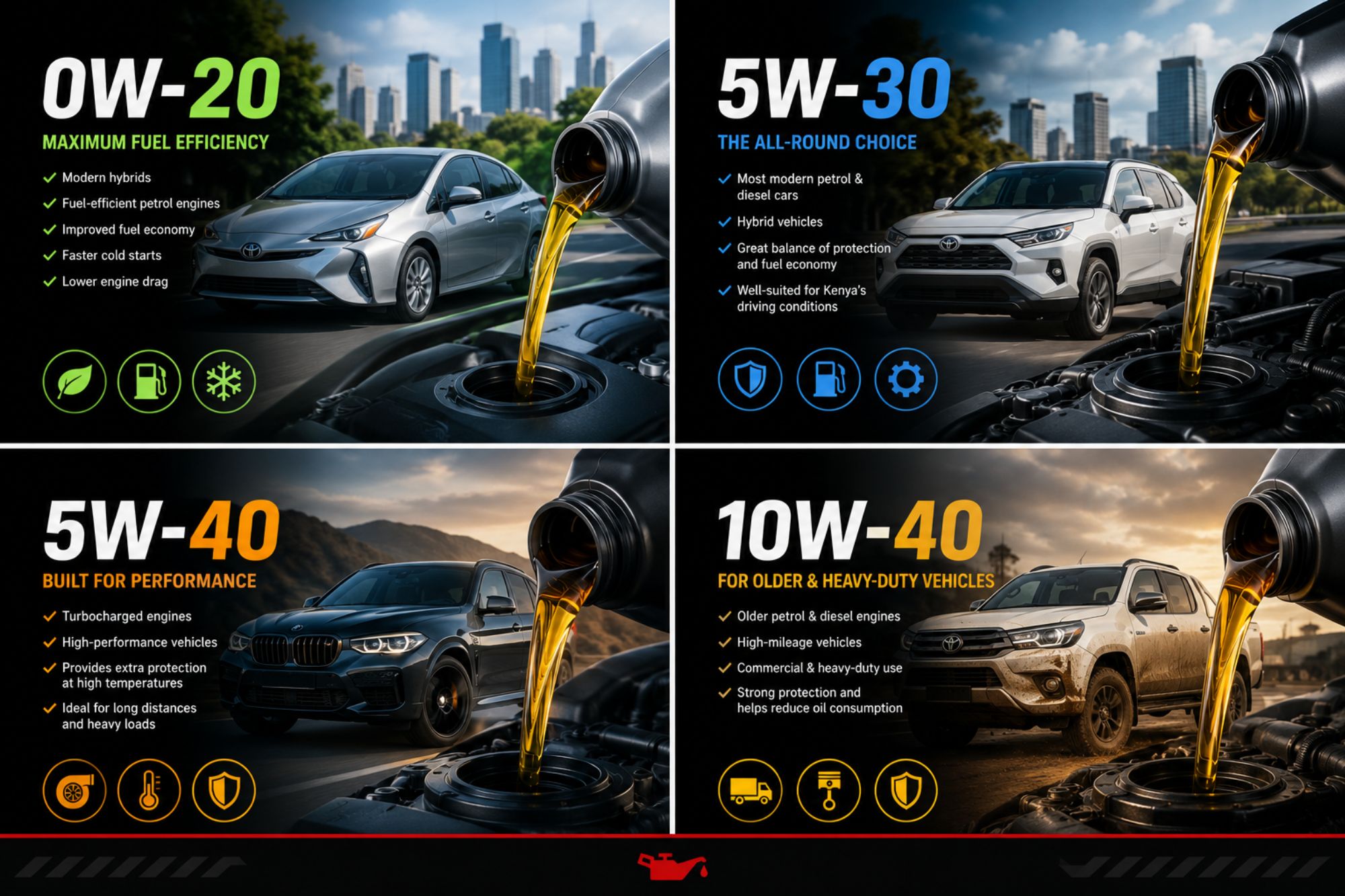
Engine oil grades such as 0W-20, 5W-30, 5W-40, and 10W-40 describe how the oil performs in different temperatures.
The first number (before the “W”) indicates how the oil flows during cold starts. The second number indicates how thick the oil remains when the engine reaches operating temperature.
For example:
- 0W-20 flows very easily during cold starts and remains relatively thin at operating temperature.
- 5W-30 offers a balance between fuel efficiency and engine protection.
- 5W-40 provides additional protection for higher-performance and turbocharged engines.
- 10W-40 is thicker when hot and is often used in older engines or heavy-duty applications.
0W-20: Rare in Practice, Not the Default Anyone Should Reach For
Where it’s actually relevant in Kenya:
- Newer hybrid imports (Toyota Aqua, Prius, Vitz Hybrid, Honda Fit Hybrid/e:HEV) that are still relatively young in the fleet
- A small, growing number of newer petrol imports specifying it from new
Kenyan Perspective:
Kenya’s climate does not require ultra-thin oils for cold-weather protection. 0W-20 is expensive, not stocked by most independent garages or small quick-lube shops, and largely irrelevant to the 8+ year-old fleet.
5W-30: Common on Paper, Complicated in Practice for Older Cars
Commonly used in:
- Modern petrol vehicles
- Many diesel passenger cars
- Some hybrid vehicles
- Small SUVs and crossovers
Kenyan Perspective:
5W-30 is widely regarded as the most versatile engine oil for Kenyan motorists and is recommended by many manufacturers for everyday driving.
While 5W-30 was the factory specification for many vehicles when they were new, engines that are over 10 years old and have travelled more than 150,000 km often experience wear, such as worn piston rings, tired valve seals, and minor leaks. As a result, many experienced Kenyan mechanics choose to use a slightly thicker oil, such as 5W-40 or even 15W-40/20W-50, to reduce oil consumption, minimise blue smoke, and decrease the frequency of oil top-ups, even if it is not in line with the original factory specification.
5W-40: Ideal for Turbocharged and High-Performance Engines
Commonly used in:
- Turbocharged petrol engines
- Modern diesel engines
- European vehicles
- High-mileage vehicles requiring additional protection
Kenyan Perspective:
Drivers who frequently travel long distances, tow trailers, carry loads, or drive in hot conditions might benefit from using 5W-40 oil, provided it is approved by the manufacturer and consistent with the engine’s condition, as assessed by a qualified mechanic.
10W-40: Common in Older and High-Mileage Vehicles
Commonly used in:
- Older petrol engines
- Older diesel vehicles
- Commercial vehicles
- Pick-ups and 4x4s higher mileage
Kenyan Perspective:
Many older vehicles on Kenyan roads continue to use 10W-40 successfully, particularly where engine wear has increased oil consumption. This oil grade is among the most commonly used in the country; it is affordable and widely available.
15W-40 and 20W-50: Common in Heavy-Duty Commercial Vehicles and 4x4s
Commonly used in:
- Older petrol engines
- Older diesel vehicles
- Commercial vehicles
- Pick-ups and 4x4s with higher mileage
Kenyan Perspective:
Many roadside and independent garages recommend using 15W-40 or 20W-50 oil due to their cost-effectiveness and their ability to reduce smoking and oil burn-off in older engines, even if this advice differs from the manufacturer’s recommendations.
However, using 20W-50 oil in engines equipped with variable valve timing (VVT-i) or a turbocharger can cause serious damage, as these engines need oil to flow quickly through narrow passages. It is essential to consult a qualified mechanic who regularly works on your specific model for a proper engine assessment.il flows during start-up.
What Is the Difference Between Mineral, Semi-Synthetic, and Fully Synthetic Oil?
Mineral Oil
Mineral oil is refined directly from crude oil.
Advantages:
- Lower cost
- Suitable for older vehicles
Disadvantages:
- Shorter lifespan
- Lower performance
Semi-Synthetic Oil
Semi-synthetic oil combines mineral and synthetic oils.
Advantages:
- Better protection
- Improved performance
- Affordable pricing
It is commonly used in many vehicles operating in Kenya.
Fully Synthetic Oil
Fully synthetic oil is engineered for maximum performance.
Advantages:
- Superior protection
- Better fuel efficiency
- Longer service intervals
- Improved performance under extreme conditions
Disadvantages:
- Higher cost
Many modern vehicles recommend fully synthetic oil.
How Often Should You Change Engine Oil?
The correct interval depends on:
- Vehicle manufacturer recommendations
- Oil type
- Driving conditions
- Vehicle age
Typical guidelines include:
Mineral Oil
Every 5,000 km
Semi-Synthetic Oil
Every 5,000–8,000 km
Fully Synthetic Oil
Every 8,000–15,000 km
Always consult your owner’s manual for the correct interval.
Why Do Kenyan Driving Conditions Matter?
Vehicle manufacturers often base service schedules on ideal conditions.
Kenyan motorists frequently face:
- Stop-and-go traffic
- Dusty roads
- High ambient temperatures
- Heavy loads
- Long-distance driving
These conditions can accelerate oil degradation. As a result, many mechanics recommend slightly shorter service intervals than those used in Europe or Japan.
How Do You Check Engine Oil?
Checking engine oil is one of the simplest maintenance tasks motorists can perform.
Step 1
Park on level ground.
Step 2
Switch off the engine and allow it to cool.
Step 3
Remove the dipstick.
Step 4
Wipe it clean.
Step 5
Reinsert it fully.
Step 6
Remove it again and inspect the oil level.
The oil should fall between the minimum and maximum marks.

What Are the Signs Your Engine Oil Needs Attention?
Watch for:
- Dashboard Oil Warning Light: This should never be ignored.
- Dark, Dirty Oil: Contaminated oil may indicate it is due for replacement.
- Increased Engine Noise: Lack of lubrication can cause unusual engine sounds.
- Poor Fuel Economy: Old oil increases friction and reduces efficiency.
- Burning Oil Smell: This could indicate leaks or overheating.
- Excessive Exhaust Smoke: In some cases, oil consumption may indicate internal engine problems.
What Is an Oil Filter and Why Is It Important?
The oil filter removes contaminants from the engine oil.
Without a functioning oil filter:
- Dirt circulates through the engine
- Wear increases
- Oil quality deteriorates rapidly
For this reason, the oil filter should typically be replaced whenever the engine oil is changed.
Can You Use Any Engine Oil?
No.
Using the wrong oil can:
- Reduce engine protection
- Increase fuel consumption
- Affect emissions systems
- Void manufacturer warranties
Always use oil that meets your vehicle manufacturer’s specifications.
CN Buyer’s Note
The cheapest oil is not always the best value. High-quality oil often provides better protection, longer service life, and improved engine performance.
Counterfeit and Adulterated Oil: Buying from authorised dealers and reputable retailers (branded service stations, established parts dealers, official brand outlets) and checking seals/batch codes matters as much as picking the right grade.
Frequently Asked Questions
It is generally not recommended. Different oil formulations may not be fully compatible.
For many modern vehicles, yes. Synthetic oil often provides superior protection and longer service intervals.
Oil consumption can occur due to wear, leaks, or engine design characteristics. Excessive consumption should be investigated.
Too much oil can cause foaming, increased pressure, and engine damage.
Yes. Most manufacturers recommend replacing the oil filter whenever the engine oil is changed.
CN Key Takeaways
✔ Engine oil reduces friction and protects critical engine components.
✔ Regular oil changes help prevent costly engine repairs.
✔ Different engines require different oil grades and specifications.
✔ Kenya’s driving conditions can accelerate oil degradation.
✔ Oil filters are essential for keeping engine oil clean.
✔ Using the correct oil improves performance, fuel economy, and reliability.
✔ Engine oil is one of the most important factors in long-term engine health.
Conclusion
Engine oil is often described as the lifeblood of an engine, and for good reason. It lubricates, cools, cleans, and protects the components that keep your vehicle moving.
Ignoring oil maintenance can lead to reduced performance, higher fuel consumption, and expensive mechanical failures. Fortunately, regular oil changes are among the simplest and most cost-effective forms of vehicle maintenance.
By understanding oil grades, choosing the correct lubricant, monitoring oil levels, and following the recommended service schedule, Kenyan motorists can extend engine life, improve reliability, and reduce long-term ownership costs.
Your engine works hard every day. Give it the protection it deserves.
Continue Reading on CarNews KE
- Why Regular Car Maintenance Saves You Money
- The True Cost of Car Ownership in Kenya
- Diesel Myths and Diesel Car Care
- Petrol vs Diesel: Which Is Better for Kenyan Drivers?
- Understanding Kenya’s Fuel Pricing Formula
- Join the CarTalk KE Forum and Share Your Vehicle Maintenance Experience









No Comment! Be the first one.