










Complete Guide to Kenya’s Fuel Pricing Formula
Understanding Kenya's fuel pricing formula helps motorists anticipate monthly price changes and promotes transparency. This guide outlines the key components of the pricing structure.

CN Quick Facts
- Kenya’s fuel pricing formula determines the maximum retail price of petrol, diesel, and kerosene.
- Fuel is one of the largest household and business expenses in Kenya.
- More than half of the fuel price paid by Kenyan motorists consists of taxes, levies, and related charges.
- Understanding the fuel pricing formula helps motorists know exactly what they are paying for and why pump prices change every month.
Understanding Every Tax, Levy and Cost in Your Pump Price
Every month, the Energy and Petroleum Regulatory Authority (EPRA) announces new maximum pump prices for petrol, diesel, and kerosene. For many motorists, the focus is usually on whether prices have increased or decreased. However, few people understand how those prices are actually calculated.
What's in this Article
- Understanding Every Tax, Levy and Cost in Your Pump Price
- Who Determines Fuel Prices in Kenya?
- What Are the Main Components of Kenya’s Fuel Price?
- What Is the Landed Cost of Fuel?
- Why Do Global Oil Prices Affect Kenyan Fuel Prices?
- How Much of Your Fuel Price Goes to Taxes and Levies?
- What Is Excise Duty on Fuel?
- What Is Value Added Tax (VAT) on Fuel?
- What Is the Railway Development Levy?
- What Is the Import Declaration Fee?
- What Is the Merchant Shipping Levy?
- What Is the Anti-Adulteration Levy?
- What About the RMLF, PDL, and PRL?
- What Are Distribution and Marketing Costs?
- Why Are Fuel Prices Different Across Kenya?
- What Does This Mean for Motorists?
- Conclusion
One of the biggest surprises for many consumers is that the fuel itself accounts for less than half of the final pump price. The rest consists of taxes, levies, transportation costs, storage charges, and margins paid to companies that move fuel from international markets to local filling stations.
Understanding Kenya’s fuel pricing formula helps motorists make sense of monthly price changes and provides greater transparency about where their money goes. This guide explains every major component of Kenya’s fuel pricing structure and the role each tax and levy plays.
Who Determines Fuel Prices in Kenya?
The Energy and Petroleum Regulatory Authority (EPRA) publishes monthly maximum fuel prices under Kenya’s petroleum pricing framework.
These prices apply to:
- Super Petrol
- Diesel
- Kerosene
EPRA reviews market conditions every month and adjusts prices based on factors such as:
- International oil prices
- Exchange rates
- Shipping costs
- Taxes and levies
- Distribution costs
CN Explained: What Is EPRA?
The Energy and Petroleum Regulatory Authority (EPRA) regulates Kenya’s energy and petroleum sectors.
Among its responsibilities are:
- Monitoring petroleum markets
- Publishing monthly fuel prices
- Licensing petroleum businesses
- Enforcing fuel quality standards
- Protecting consumers
EPRA’s monthly fuel price review is one of the most closely watched economic announcements in Kenya.
What Are the Main Components of Kenya’s Fuel Price?
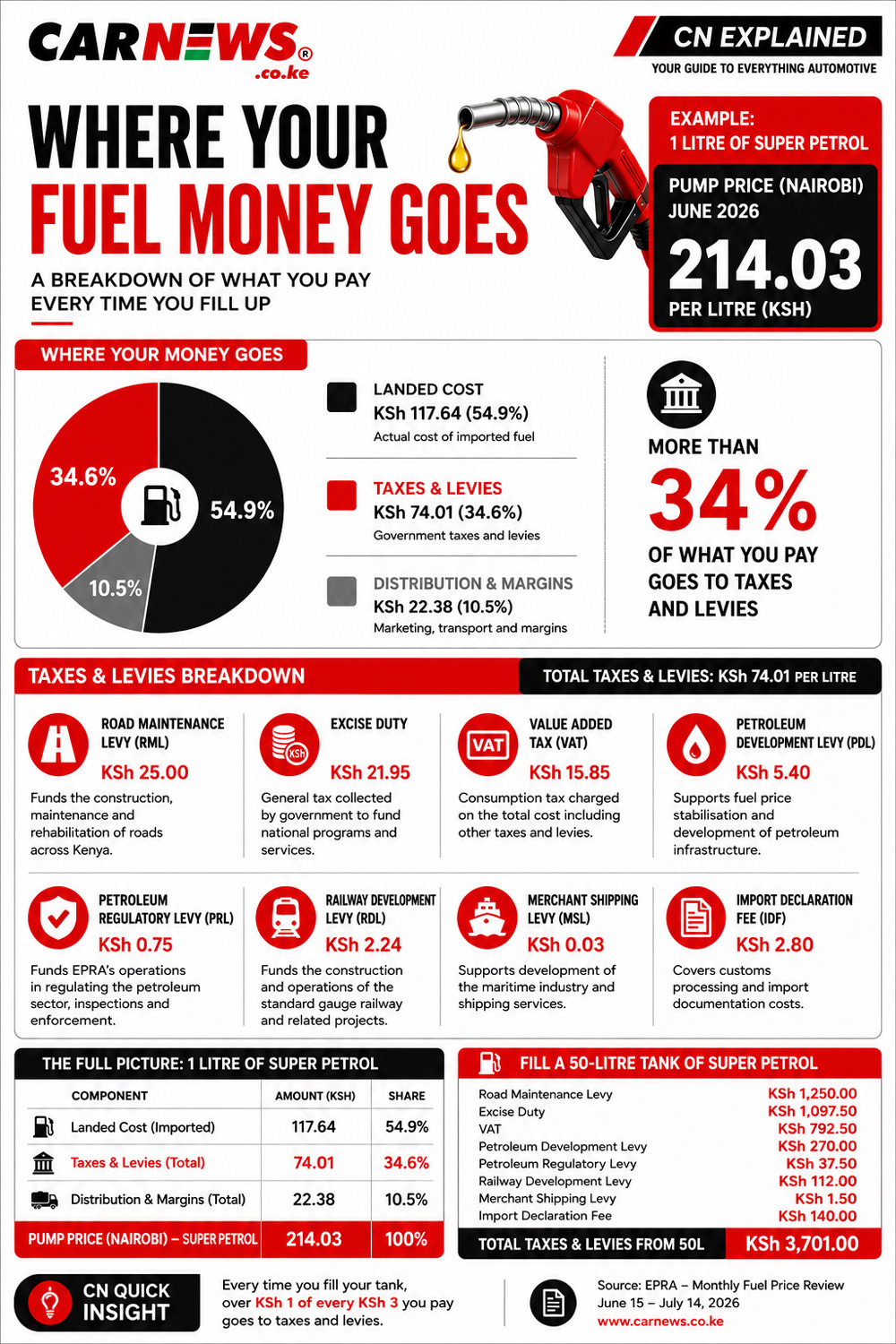
The final pump price can be divided into three broad categories:
1. Landed Cost: The cost of importing fuel into Kenya.
2. Taxes and Levies: Government-imposed charges added to every litre.
3. Distribution and Marketing Costs: The cost of transporting, storing, and selling fuel to consumers.
Let’s examine each component in detail.
What Is the Landed Cost of Fuel?
The landed cost represents the price of bringing fuel into Kenya before local taxes and distribution costs are added.
It includes:
- Cost of purchasing fuel
- Marine insurance
- Freight charges
- Port handling costs
- Inspection costs
- Financing charges
The landed cost fluctuates based on:
- Global crude oil prices
- Refined fuel prices
- Exchange rates
- International shipping costs
This is usually the largest variable component of the pricing formula.
Why Do Global Oil Prices Affect Kenyan Fuel Prices?
Kenya imports most of its petroleum products. When international oil prices rise, import costs increase. Similarly, when the Kenya Shilling weakens against the US Dollar, fuel imports become more expensive because petroleum is traded globally in dollars.
This explains why fuel prices can increase even when domestic demand remains unchanged.
How Much of Your Fuel Price Goes to Taxes and Levies?
Taxes and levies account for approximately 55% to 60% of the retail pump price in Kenya.
These charges are collected by government agencies and special-purpose funds that support infrastructure, regulation, and public services.
CN Explained: Tax vs Levy
A tax generally contributes to government revenue and may be used for various public services.
A levy is usually collected for a specific purpose, such as road maintenance or petroleum sector development.
Both taxes and levies contribute significantly to the final pump price.
What Is Excise Duty on Fuel?
Excise Duty is one of the largest taxes included in Kenya’s fuel pricing structure. It is imposed on specific goods and services, including petroleum products.
Current excise duty rates differ depending on the fuel type. Revenue from Excise Duty contributes to government expenditure and public services.
Why Is Excise Duty Charged on Fuel?
Governments worldwide often impose excise taxes on fuel because:
- Fuel consumption is widespread
- Collection is relatively efficient
- Revenue generation is predictable
In Kenya, Excise Duty represents one of the largest tax components within the pump price.
What Is Value Added Tax (VAT) on Fuel?
Value Added Tax (VAT) is a consumption tax charged on goods and services. Fuel currently attracts VAT at the standard rate applied under Kenyan tax law.
One aspect that often generates debate is that VAT is applied after several other taxes and levies have already been included in the pricing structure. As a result, consumers effectively pay tax on top of certain taxes and levies.
CN Explained: Why Is VAT So Significant?
VAT is calculated on the cumulative fuel cost.
This means VAT applies not only to the imported fuel itself but also to many of the additional charges included in the pricing formula.
As fuel prices increase, VAT collections generally rise as well.
What Is the Railway Development Levy?
The Railway Development Levy (RDL) is charged on imported goods entering Kenya, including petroleum products.
The levy was introduced to support the development of national transport infrastructure, particularly railway projects.
The revenue contributes towards:
- Railway infrastructure development
- Transport network expansion
- Related infrastructure investments
Although relatively small on a per-litre basis, the levy contributes to the overall fuel cost paid by motorists.
CN Explained: Why Do Fuel Consumers Pay a Railway Levy?
Because fuel is imported, it is subject to import-related charges, including the Railway Development Levy.
The principle behind the levy is that improved transport infrastructure benefits the wider economy, including fuel distribution and logistics.
However, the levy remains one of the more debated components of Kenya’s fuel pricing formula.
What Is the Import Declaration Fee?
The Import Declaration Fee (IDF) is a charge imposed on imported goods entering Kenya.
The fee helps fund customs administration and import processing activities.
Because Kenya imports petroleum products, fuel imports are subject to this charge before reaching consumers.
What Is the Merchant Shipping Levy?
The Merchant Shipping Levy supports Kenya’s maritime sector.
Revenue collected contributes towards:
- Maritime administration
- Shipping sector development
- Port-related activities
- Marine transport oversight
Although the cost per litre is relatively small, it forms part of the cumulative charges included in fuel prices.
What Is the Anti-Adulteration Levy?
The Anti-Adulteration Levy applies primarily to kerosene.
Its purpose is to combat fuel adulteration, a practice where petroleum products are illegally mixed to evade taxes or increase profits.
The levy helps fund enforcement measures aimed at:
- Protecting consumers
- Protecting government revenue
- Maintaining fuel quality standards
What About the RMLF, PDL, and PRL?
Several major fuel levies deserve dedicated discussion because of their significant impact on motorists.
These include:
Road Maintenance Levy Fund (RMLF)
Funds road maintenance and rehabilitation projects throughout Kenya.
Read next: Understanding the Road Maintenance Levy Fund.
Petroleum Development Levy (PDL)
Supports petroleum sector development and fuel price stabilisation initiatives.
Read next: What Is the Petroleum Development Levy?
Petroleum Regulatory Levy (PRL)
Funds petroleum sector regulation, fuel quality monitoring, and consumer protection activities.
Read next: What Is the Petroleum Regulatory Levy?
What Are Distribution and Marketing Costs?
After fuel arrives in Kenya, it still needs to reach consumers.
Distribution costs include:
- Pipeline transportation
- Storage at depots
- Truck transportation
- Handling charges
- Inventory management
Marketing costs include:
- Fuel station operations
- Staff salaries
- Utilities
- Maintenance
- Dealer margins
These costs ensure fuel is available throughout the country.
Why Are Fuel Prices Different Across Kenya?
Fuel transported further from Mombasa generally costs more.
This is because of:
- Additional transport expenses
- Logistics costs
- Storage requirements
As a result, motorists in some counties may pay higher prices than those in Nairobi or Mombasa.
What Does This Mean for Motorists?
The fuel pricing formula highlights an important reality:
The price displayed at the pump is about much more than the fuel itself.
Motorists are simultaneously paying for:
- Imported petroleum products
- Road maintenance
- Petroleum regulation
- Infrastructure development
- Government revenue collection
- Distribution logistics
Understanding these costs helps consumers engage more effectively in discussions about fuel pricing and public policy.
CN Insight: Why Fuel Prices Matter Beyond the Fuel Station
Fuel affects almost every aspect of the economy.
Higher fuel prices can influence:
- Food prices
- Public transport fares
- Manufacturing costs
- Freight charges
- Household budgets
This is why fuel pricing remains one of Kenya’s most important economic issues. Understanding the pricing formula allows motorists and consumers to separate global market influences from local taxes and policy decisions.
Frequently Asked Questions
EPRA publishes monthly maximum fuel prices based on Kenya’s fuel pricing formula.
Changes in international fuel prices, exchange rates, taxes, and supply costs influence monthly price adjustments.
Fuel taxes and levies help fund government services, road maintenance, petroleum regulation, and infrastructure development.
Taxes and levies typically account for approximately 35% to 60% of the retail pump price.
Excise Duty, VAT, and the Road Maintenance Levy are among the largest components of Kenya’s fuel pricing structure.
CN Key Takeaways
✔ EPRA determines Kenya’s maximum fuel prices every month.
✔ The final pump price includes imported fuel costs, taxes, levies, and distribution costs.
✔ More than half of Kenya’s fuel price consists of taxes and levies.
✔ Excise Duty and VAT are among the largest tax components.
✔ Railway Development Levy, Import Declaration Fee, Merchant Shipping Levy, and Anti-Adulteration Levy also contribute to the final fuel cost.
✔ Road Maintenance Levy, Petroleum Development Levy, and Petroleum Regulatory Levy each serve specific purposes within the petroleum sector.
✔ Understanding the fuel pricing formula helps motorists better understand why fuel prices rise and fall.
Conclusion
Kenya’s fuel pricing formula is far more complex than many motorists realise. While global oil prices and exchange rates play an important role, taxes and levies account for a substantial portion of what consumers ultimately pay at the pump.
By understanding each component, from Excise Duty and VAT to the Railway Development Levy and Import Declaration Fee, motorists gain a clearer picture of how fuel prices are structured and why they remain such an important national issue.









No Comment! Be the first one.