









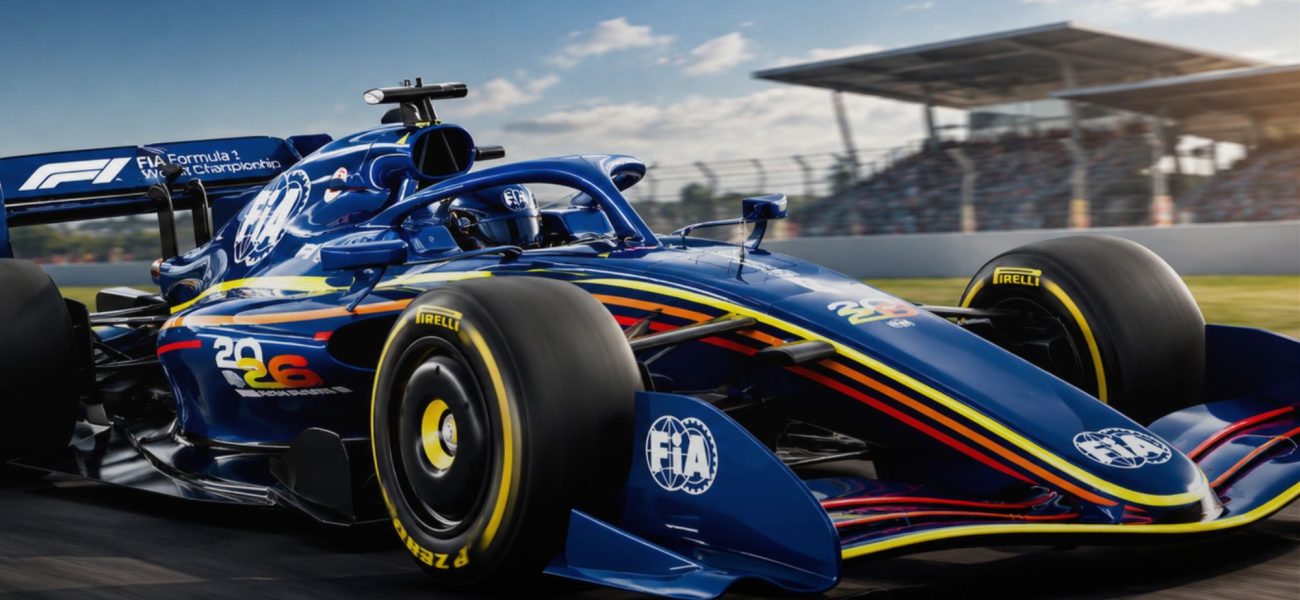
Inside the F1 Car: How a 2026 Formula One Car Works
From a 1,000-horsepower hybrid engine to wings that change shape mid-lap, here is what is inside the F1 car and how it compares with a road car.

CN Quick Facts
- Class: Formula One (F1) 2026-specification car
- Power unit: 1.6-litre V6 turbo hybrid; roughly 540 hp from the combustion engine plus roughly 470 hp from the electric motor, for over 1,000 hp combined
- Power split: About 50% combustion, 50% electric
- Minimum weight: About 768 kg, including the driver
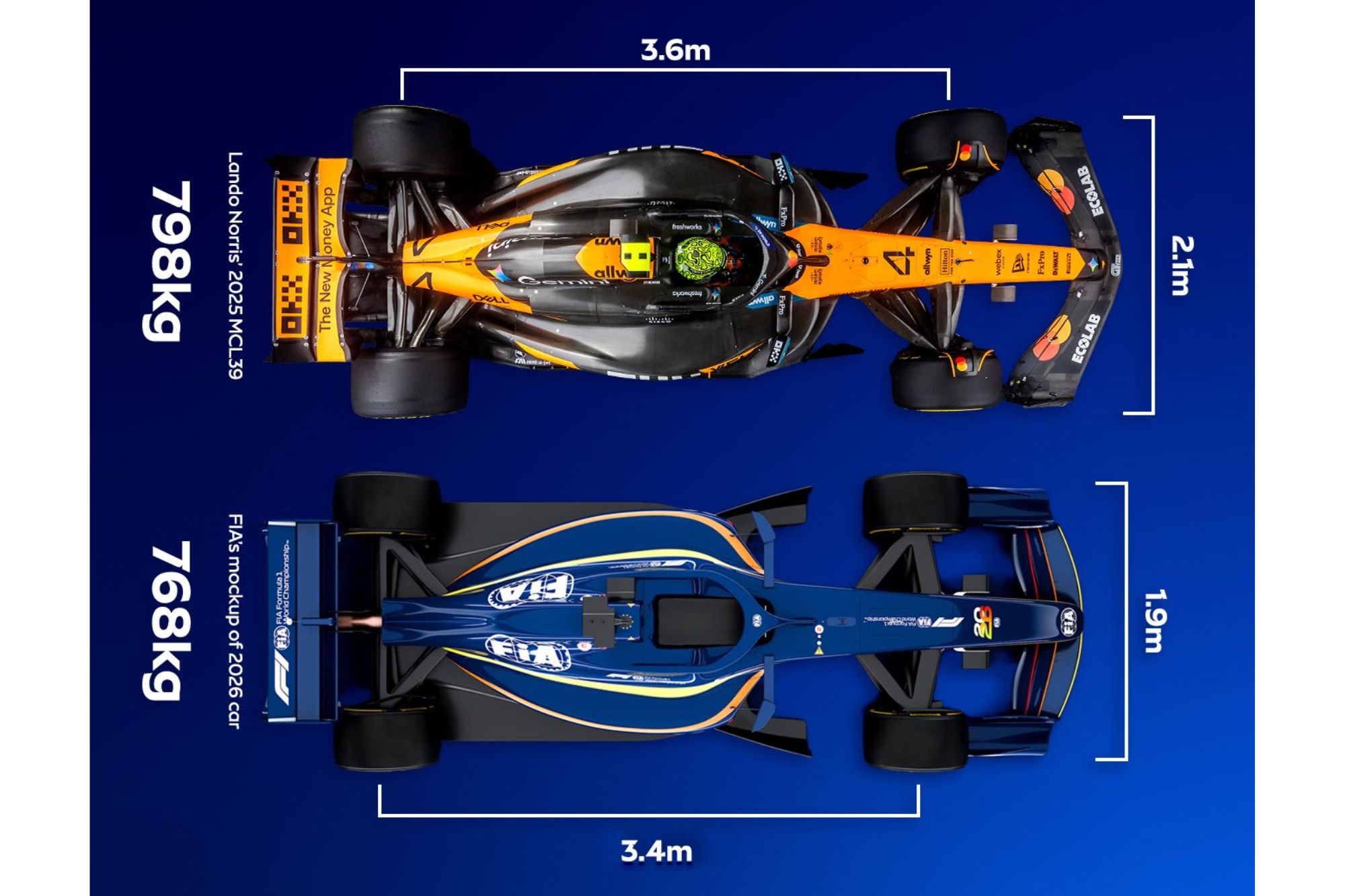
- Size: About 5,500mm long, 1,900 mm wide, 3,400 mm wheelbase
- Fuel: 100% sustainable fuel
- Aerodynamics: Active aero with Corner Mode and Straight Mode; Overtake Mode replaces the Drag Reduction System (DRS)
- Tyres: Pirelli, 18-inch wheels
- Top speed: Well over 300 km/h
What's in this Article
- What Is Inside the F1 Car?
- How Powerful is the 2026 F1 Power Unit?
- How Does Active Aerodynamics Work?
- How Do F1 Tyres and Brakes Cope with Extreme Forces?
- What Does the Driver Control From the Cockpit?
- How Has the F1 Car Evolved Over 75 Years?
- How Does an F1 Car Compare With a Road Car?
- Who Would Win: A Rally1 Car or A Formula One Car?
- What Happens Next?
- Conclusion
What Is Inside the F1 Car?
Inside the F1 car is one of the most advanced racing machines on the planet: a carbon-fibre shell wrapped around a hybrid power unit, a gearbox, a battery, a cooling system and a cockpit designed to keep one driver safe at speeds above 300 km/h. Nothing is there for comfort, and almost every part has been designed to do two jobs at once.
At the centre is the monocoque, also called the survival cell. It is a single moulded shell of carbon fibre and aluminium honeycomb that holds the driver, the fuel tank and the front suspension mounting points. It is extremely light yet strong enough to survive crashes that would destroy a road car. The rest of the car bolts onto this shell: the power unit and gearbox at the back, the nose and front wing at the front, and the floor and sidepods in between.
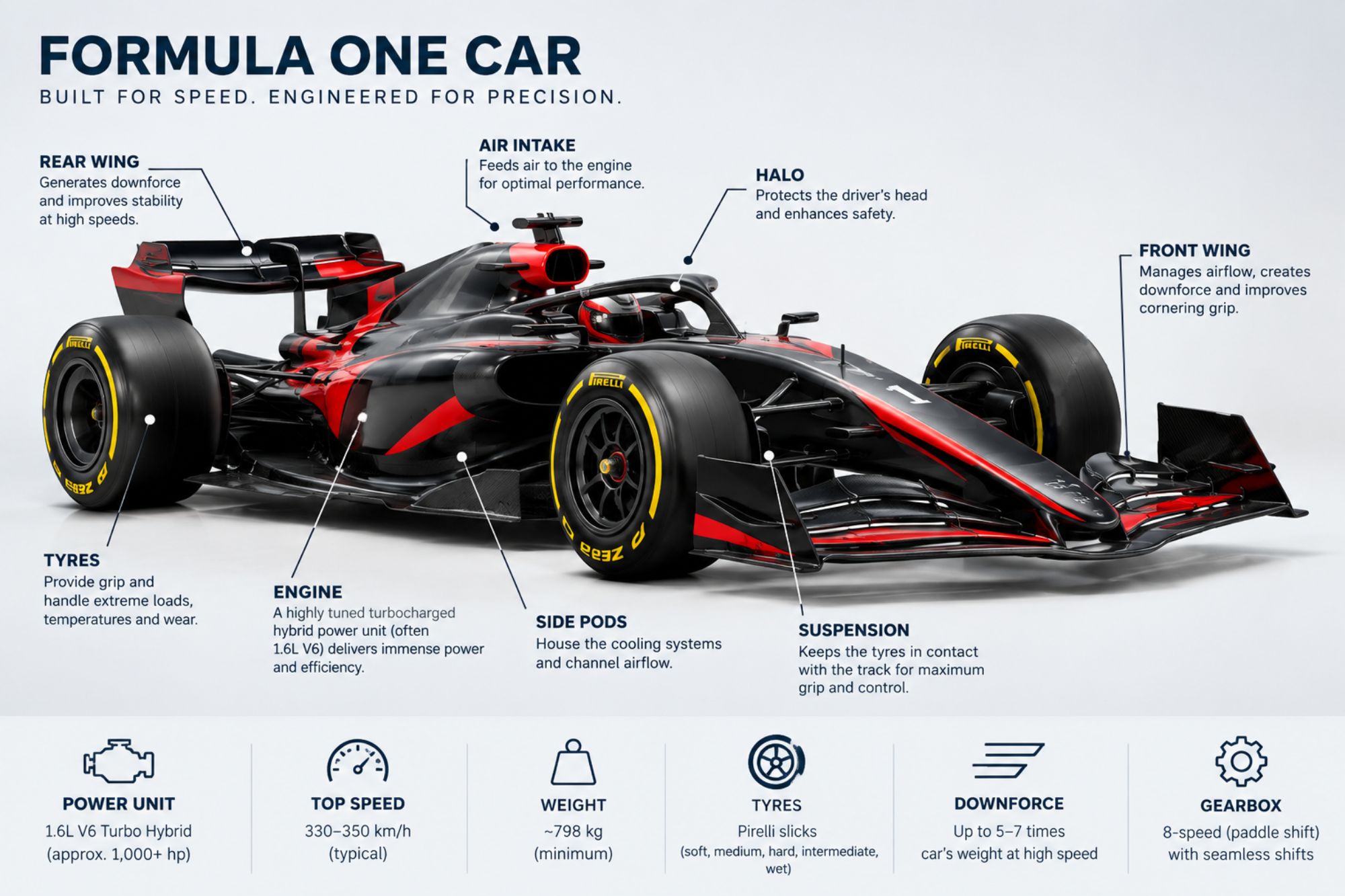
The parts you can see from the grandstand are only half the story. The underside of the car, the cooling inlets, the brake ducts and the shape of the floor are all tuned to move air in a precise way.
Key Details: the 2026 car at a glance
| Item | 2026 F1 Car |
|---|---|
| Chassis | Carbon-fibre monocoque with halo cockpit protection |
| Engine | 1.6-litre V6 turbo, direct injection |
| Electrical system | Much larger motor-generator unit (MGU-K) and battery; MGU-H removed |
| Gearbox | Eight-speed semi-automatic, paddle shift |
| Minimum weight | About 768 kg with driver |
| Width and wheelbase | 1,900 mm wide; 3,400 mm wheelbase |
| Wheels and tyres | 18-inch wheels; front tyres 25 mm narrower and rear tyres 30 mm narrower than in 2025 |
| Fuel | 100% sustainable fuel |
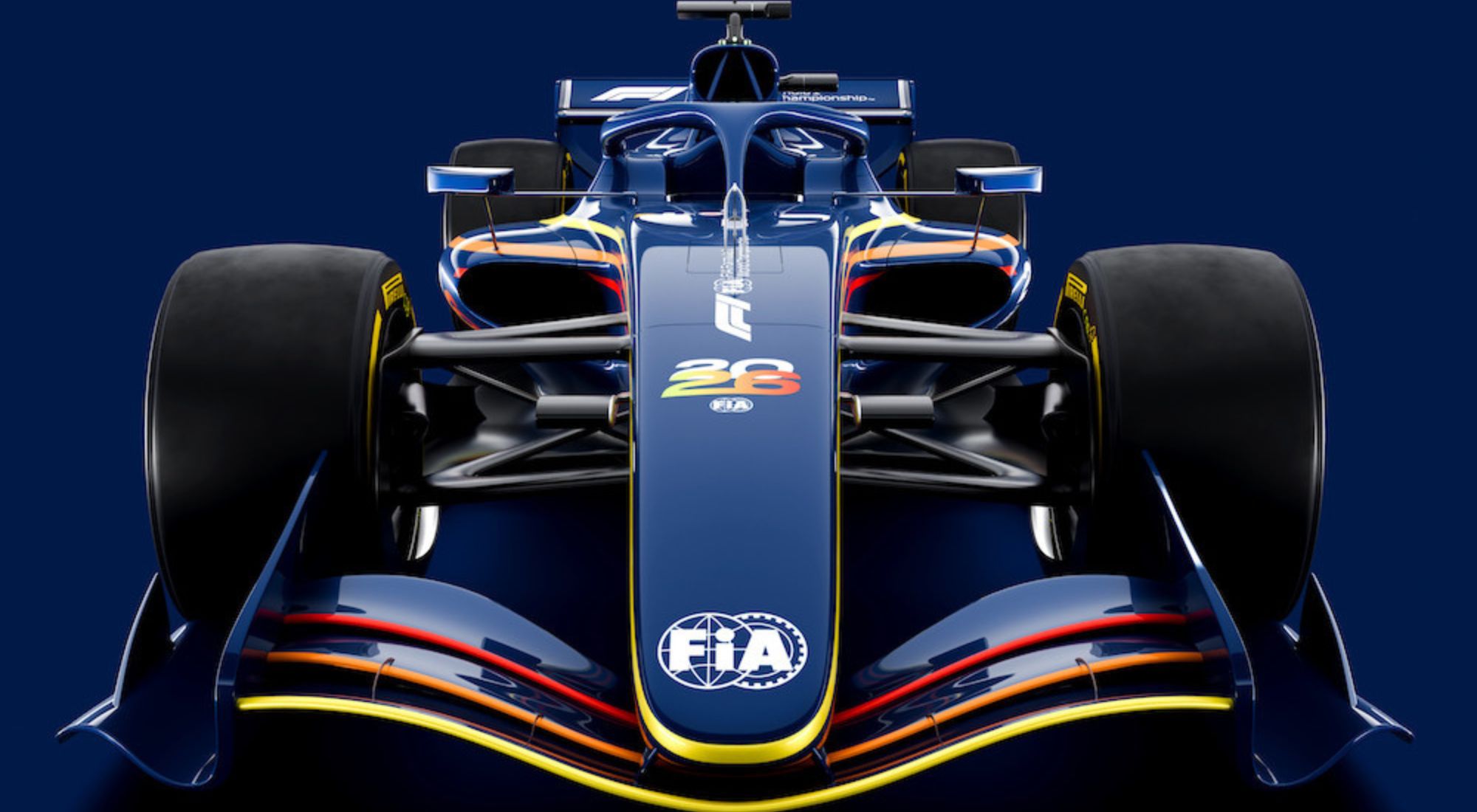
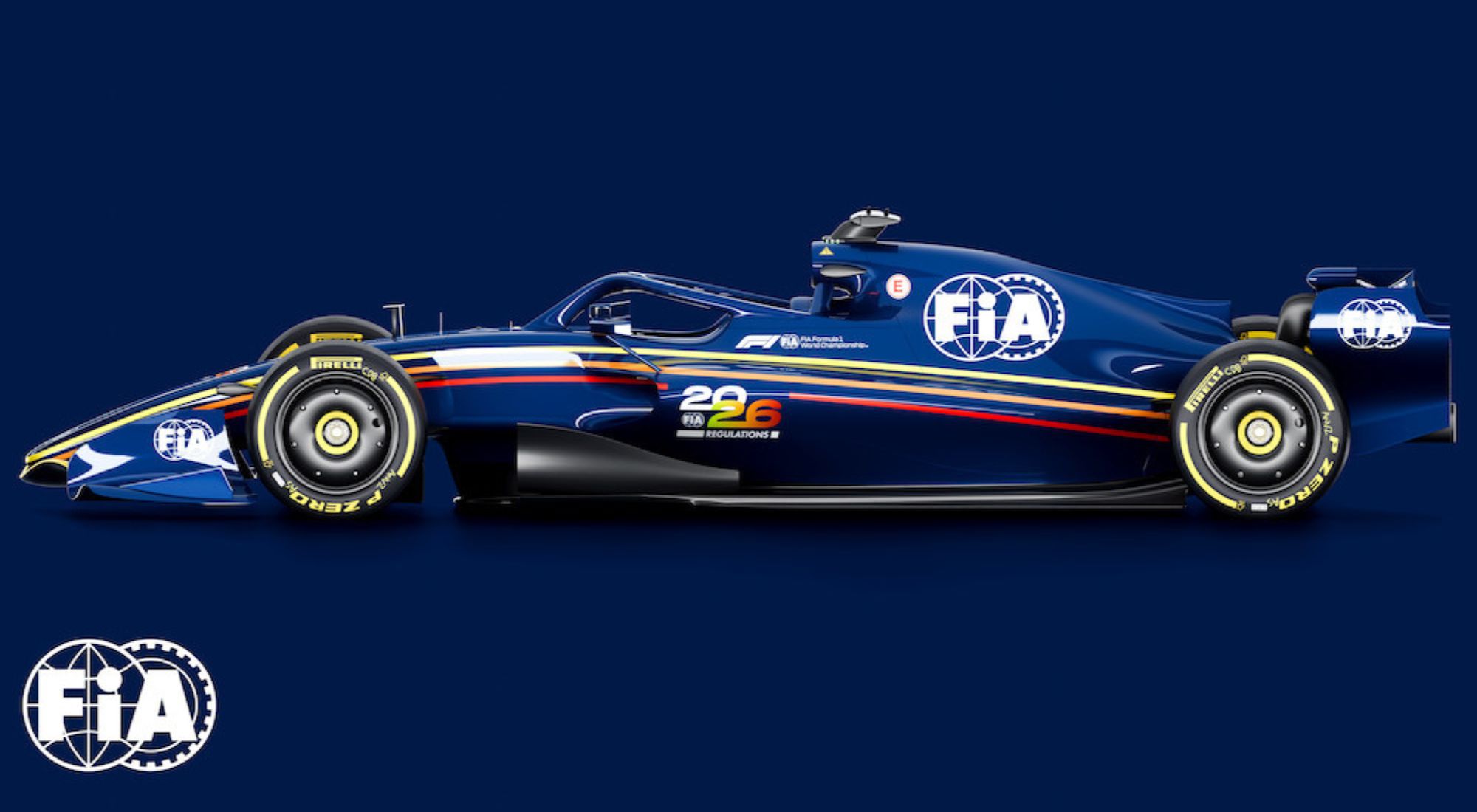
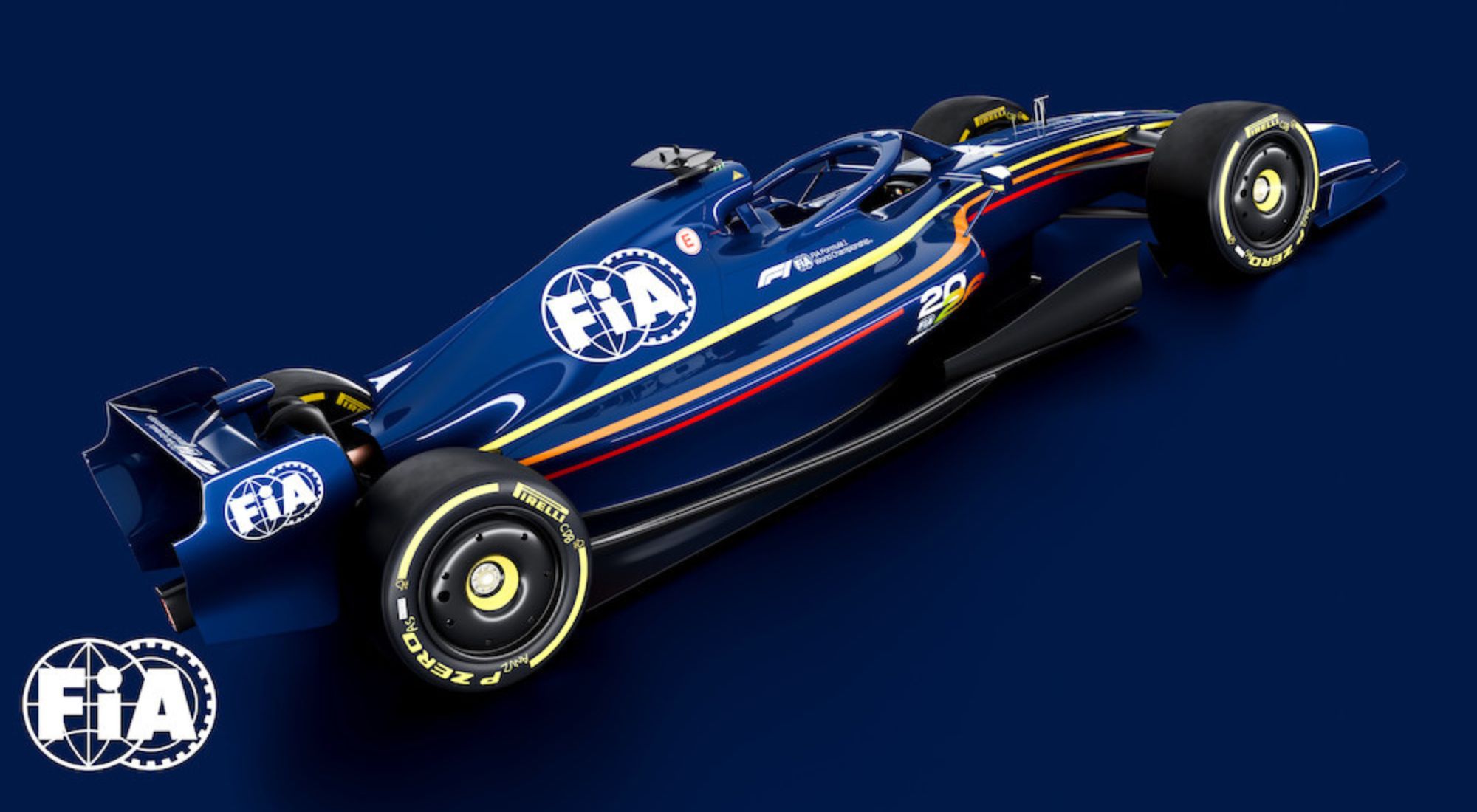
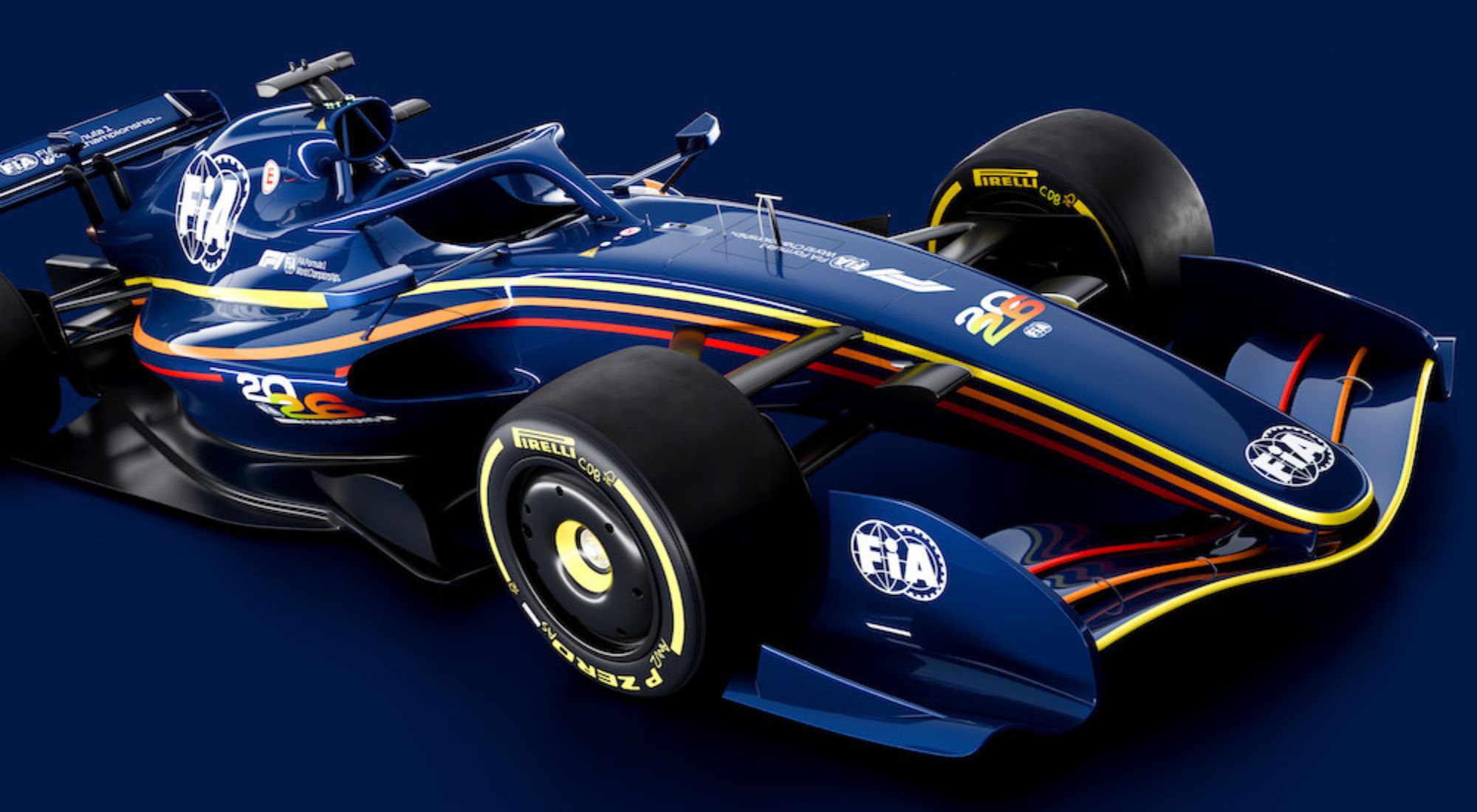
The 2026 car is about 30 kg lighter, 100 mm narrower and has a wheelbase 200 mm shorter than the 2025 car. The idea behind the change is a smaller, more agile car that can follow another car more closely and race wheel to wheel.
How Powerful is the 2026 F1 Power Unit?
The 2026 F1 power unit combines a 1.6-litre turbocharged V6 petrol engine with a powerful electric motor. The two now produce roughly equal amounts of power. Reported figures put the combustion engine at just under 540 hp and the electric motor at around 470 hp, which adds up to more than 1,000 hp when both are working at full power.
The main changes for 2026 are:
- More electric power. The electric side has roughly tripled in output compared with the previous generation, giving the near 50/50 split between combustion and electrical power.
- No MGU-H. The Motor Generator Unit-Heat, a complicated and expensive part that recovered energy from the exhaust, has been removed. Teams now rely on the MGU-K, which recovers energy under braking, and on the turbo design.
- 100% sustainable fuel. The fuel is made from non-fossil sources, such as waste or synthetic components. This was a major reason Audi and Honda committed to the sport.
- Energy management as a skill. Battery energy is limited, so drivers must harvest and deploy it carefully through the lap. The driver’s right foot, steering-wheel settings and track position all affect how much power is available.
The new rules also give drivers power modes. Boost Mode gives full combined power at the press of a button, Overtake Mode gives an attacking driver extra electrical power and Recharge harvests energy more aggressively.
How Does Active Aerodynamics Work?
Aerodynamics is the science of how air flows over the car. An F1 car is designed to use air to push itself down onto the track. This force, called downforce, lets the car corner at speeds far beyond what the tyres alone could hold.
In 2026 the car features active aerodynamics, meaning the front and rear wings move during a lap. There are two main modes:
- Corner Mode (Z-mode): The wings stay in a high-downforce position for braking and cornering, adding grip.
- Straight Mode (X-mode): The wings flatten to cut drag on the straights so that the car can reach higher speeds with less power.
The previous Drag Reduction System (DRS), which was a single flap on the rear wing available only to a chasing driver within one second of the car ahead, has been scrapped. Active aero is now available to every driver on every lap, and Overtake Mode, which uses electrical power rather than a flap, is the new overtaking tool.
The floor of the car also matters. It creates a low-pressure area underneath, which sucks the car towards the track. The 2026 floor is narrower than before, but still produces large amounts of downforce.
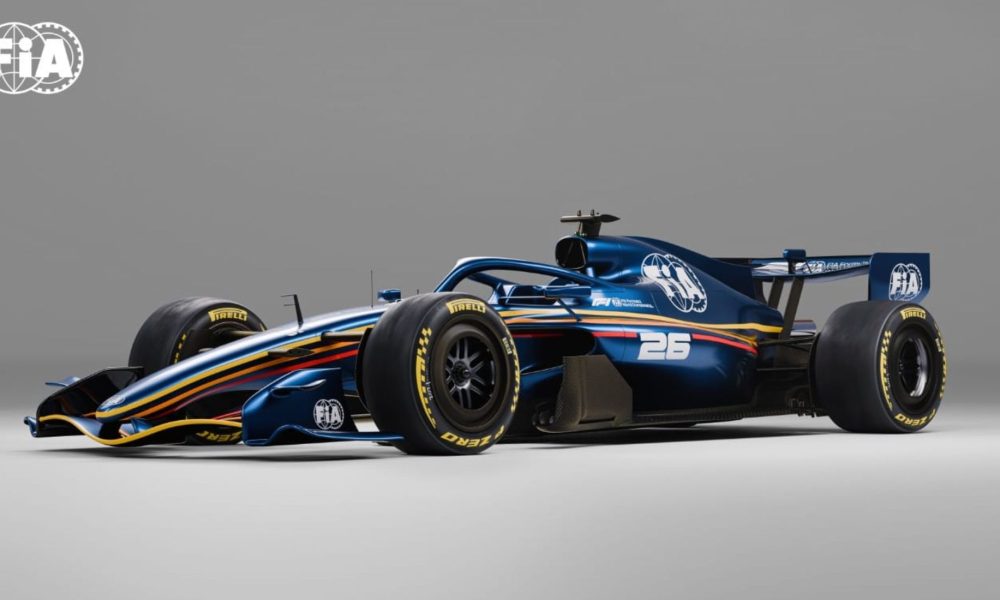 2026 FIA Technical Regulations F1 Car
How Do F1 Tyres and Brakes Cope with Extreme Forces?
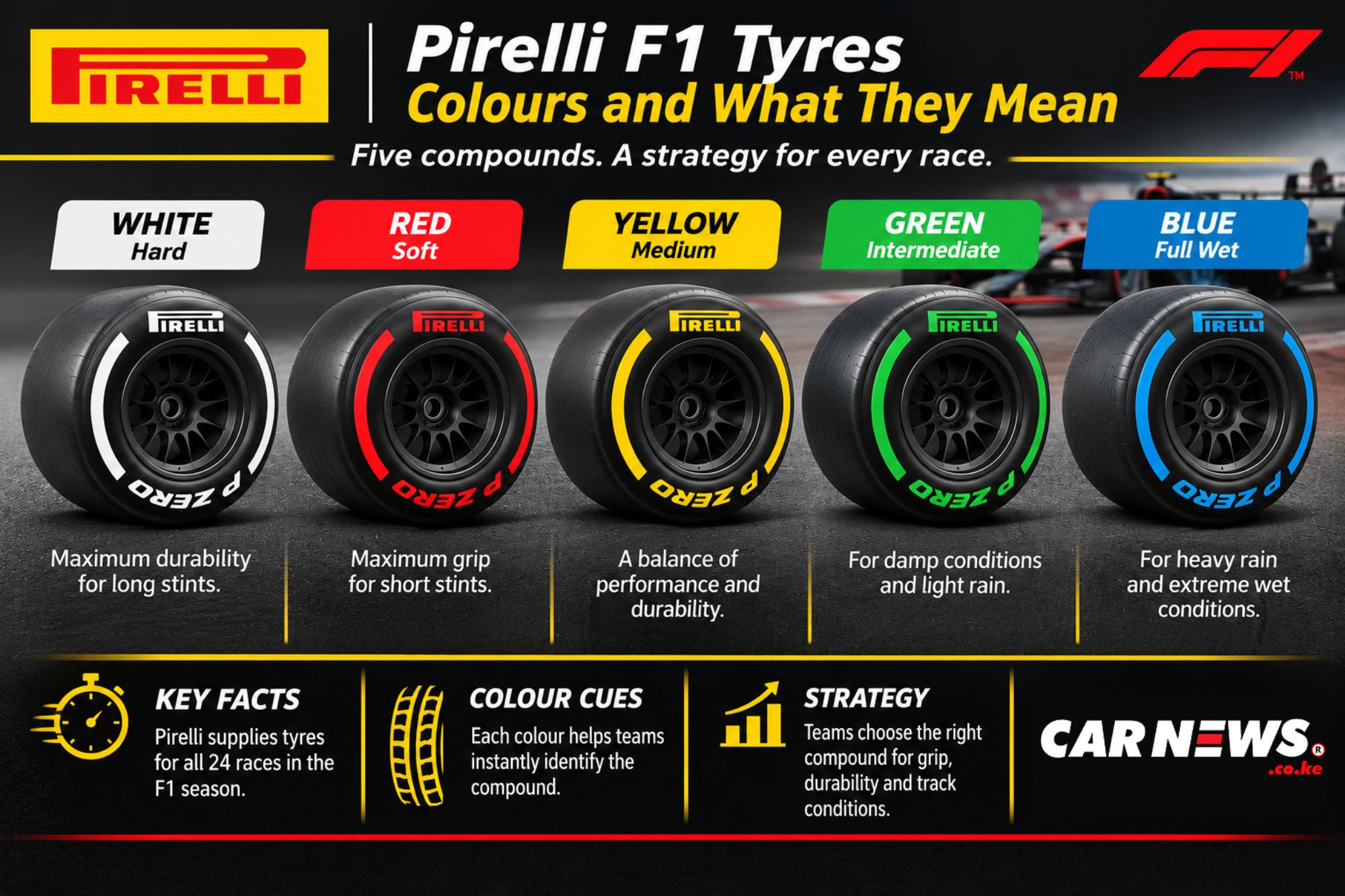
Tyres. Pirelli supplies every team with the same tyres, on 18-inch wheels. For dry races, the tyres come in several slick compounds that range from hard and durable to soft and fast. For wet conditions, there are intermediate and full-wet tyres. Each compound has a different grip level and lifespan, and picking when to change them is a core part of race strategy. For 2026, the tyres are narrower than before, which reduces weight and drag.
Brakes. F1 cars use carbon-carbon brake discs that work at very high temperatures, which is why drivers say the brakes only work properly when they are hot. The brakes can slow the car from over 300 km/h to a fraction of that in only a few seconds, with drivers feeling forces several times their body weight. In 2026, the electric motor also helps to slow the car, recovering energy as it does so.
The forces on the driver. Under heavy braking and in fast corners, a driver can experience around five times their body weight pushing on the body. This is why F1 drivers train their neck and core muscles so intensively.
What Does the Driver Control From the Cockpit?
The F1 steering wheel is not a normal wheel. It is a small computer with dozens of buttons, switches and rotary dials. The driver uses it to change gears with paddles, adjust brake balance, change engine and energy modes, talk to the team over the radio, activate Overtake Mode and set how the differential behaves in corners.
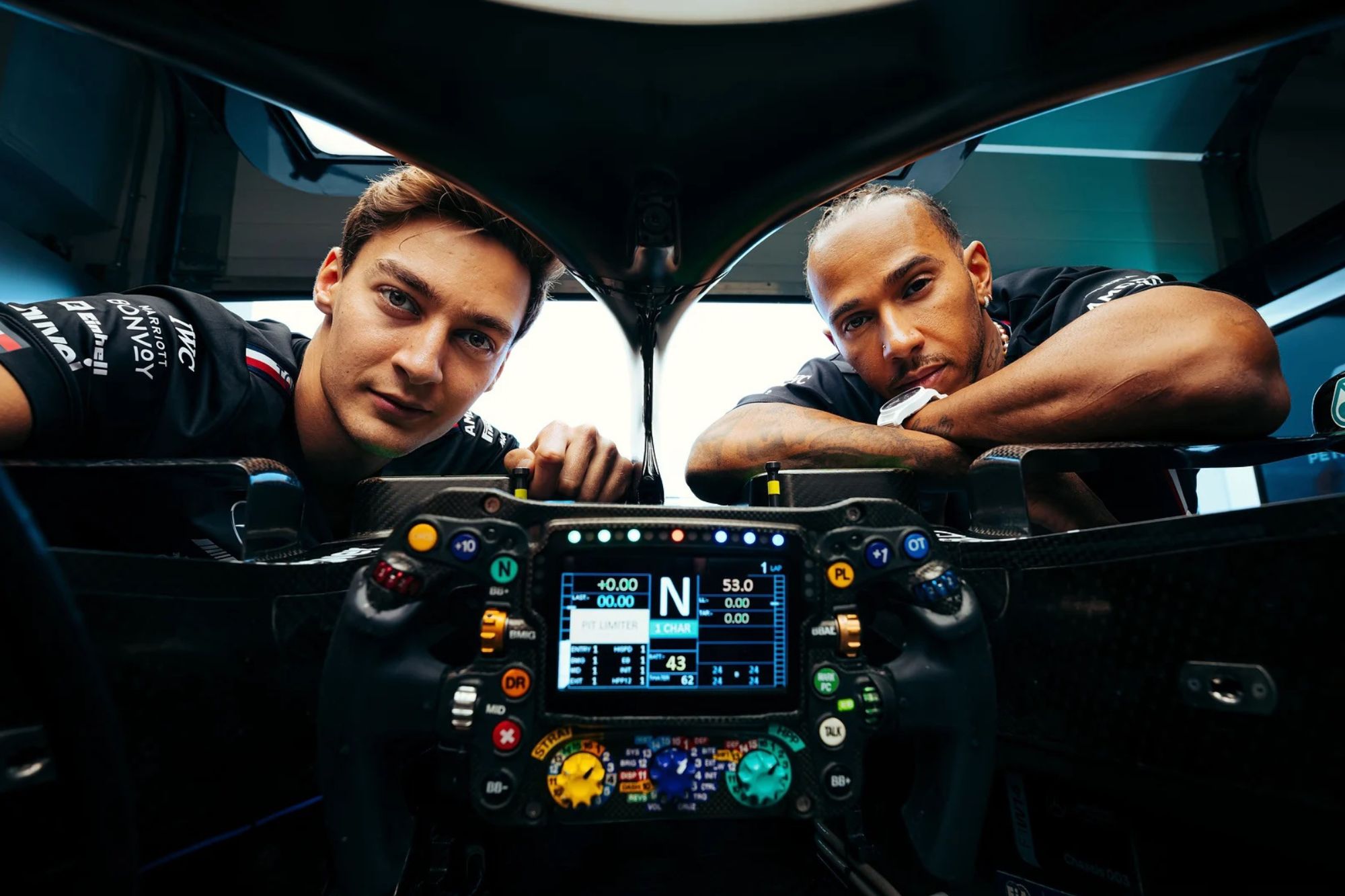
The gearbox has eight forward gears, shifts in milliseconds, and is operated entirely by paddles behind the wheel. There is no clutch pedal during a race, only a clutch paddle that is used at the start.
Can a Formula One car reverse? Yes. FIA (Fédération Internationale de l’Automobile) regulations require every F1 car to have a working reverse gear, in addition to the eight forward gears, and the driver can select it using a control in the cockpit. It is used mainly in the pits and garage, and by drivers who spin or run wide and need to turn the car around to rejoin the track. Reversing is slow and awkward, though, because the car sits very low and has limited steering lock. If a car is beached in a gravel trap or has damaged drive components, reverse will not get it out, and the driver’s race is over.
The driver sits in a reclined position, with the feet higher than the hips, in a seat moulded to their body. Around the driver is the halo, a titanium protection structure above the cockpit that deflects debris and protects the head in crashes, and has been proven in several serious accidents since it was introduced in 2018.
CN Explained: What do the F1 car terms mean?
Term What it means Monocoque The carbon-fibre survival cell that holds the driver and the fuel tank Power unit The engine, turbo, electric motor, battery and control electronics together, not just the engine MGU-K Motor Generator Unit-Kinetic: recovers energy when braking and adds electric power when accelerating ERS Energy Recovery System: the electrical side of the power unit Downforce Aerodynamic force that presses the car onto the road, boosting grip in corners Drag Air resistance that slows the car on straights Active aero Front and rear wings that move between Corner Mode and Straight Mode Overtake Mode Extra electrical power given to a driver attacking the car ahead DRS (Drag Reduction System) The old rear-wing flap used to overtake until 2025; replaced in 2026 Halo Titanium frame above the cockpit that protects the driver’s head Slick tyre A dry-weather tyre without tread grooves
How Has the F1 Car Evolved Over 75 Years?
Background. The first F1 World Championship in 1950 was contested by front-engined cars with thin tyres and little protection for the driver.
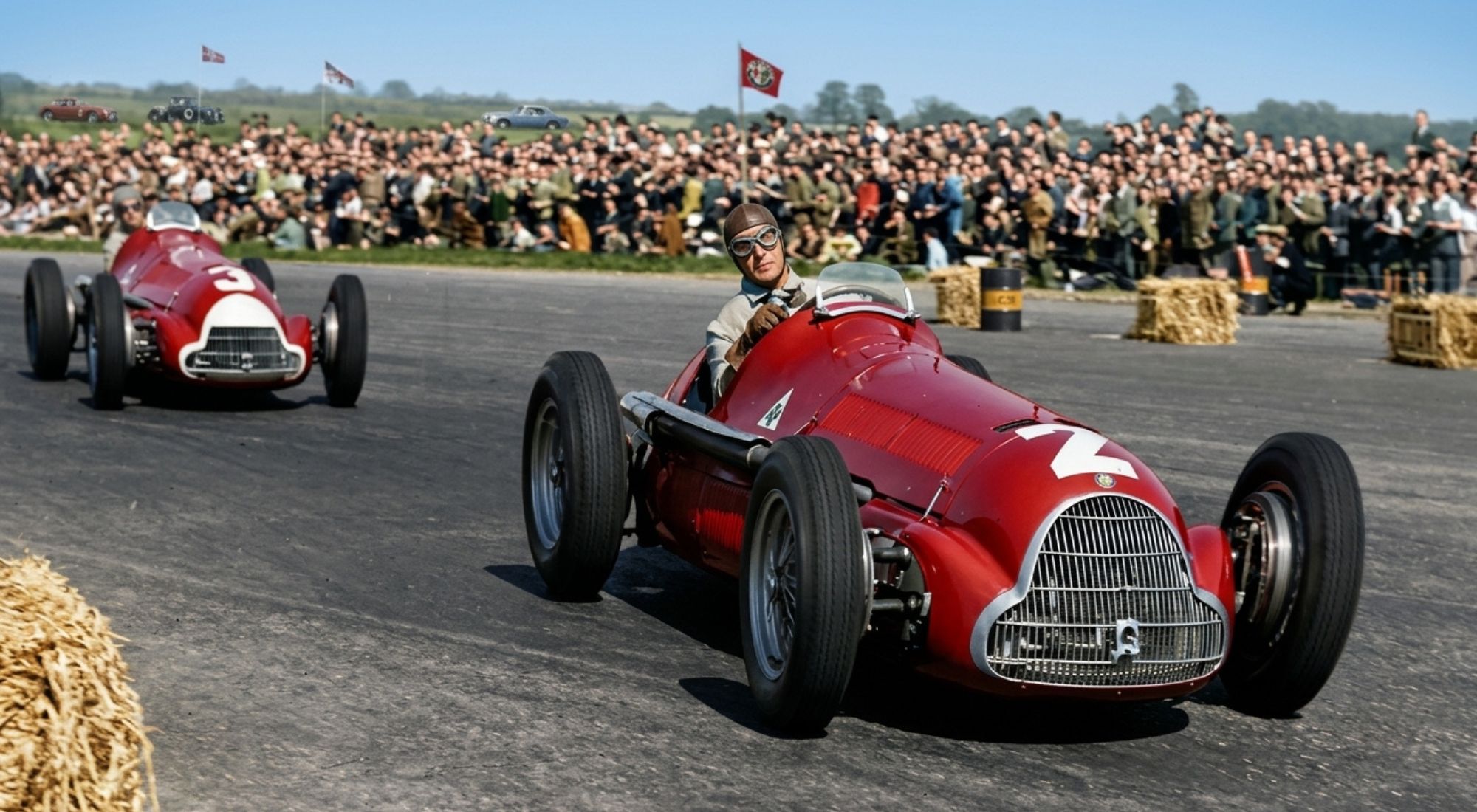
Over the decades, the car has changed in several big steps:
- 1960s: Engines moved behind the driver, which improved balance and became the norm.
- Late 1960s and 1970s: Wings were added to create downforce, and ground-effect floors followed, using the underside of the car to suck it onto the road.
- 1980s: Turbocharged engines produced huge power, and carbon-fibre chassis improved safety and stiffness.
- 2014: Hybrid V6 turbo power units arrived, with electric energy recovery for the first time.
- 2018: The halo was introduced to protect drivers’ heads.
- 2022: A new generation of cars brought back ground-effect floors to allow closer racing.
- 2026: Lighter cars, active aerodynamics, a near 50/50 split between combustion and electric power and fully sustainable fuel.
Each rule change has tried to balance three things: speed, safety and the quality of the racing.
How Does an F1 Car Compare With a Road Car?
If you compare an F1 car with a typical family car you would see on Nairobi’s Thika Road, the difference is huge. The numbers below are approximate, to give a sense of scale.
| F1 Car (2026) | Typical Family Car | |
|---|---|---|
| Power | Over 1,000 hp | About 100 to 200 hp |
| Weight | About 768 kg with driver | About 1,100 to 1,500 kg |
| Top speed | Well over 300 km/h | About 170 to 200 km/h |
| 0 to 100 km/h | Roughly 2.5 seconds | Roughly 8 to 12 seconds |
| Gearbox | Eight-speed paddle shift | Manual or automatic |
| Tyre life | Under an hour of racing | Tens of thousands of kilometres |
| Engine life | A limited number of races, with strict allocations | Hundreds of thousands of kilometres |
| Purpose | Fastest lap on a smooth circuit | Comfort, economy, daily use |
The biggest difference is not power but the power-to-weight ratio and downforce. An F1 car has roughly five to ten times the power of a typical family car while weighing about half as much. At high speed, its wings and floor push it onto the road with a force greater than its own weight, which in theory would let it drive upside down on a tunnel roof.
Who Would Win: A Rally1 Car or A Formula One Car?
It depends entirely on the surface. On a smooth circuit, the F1 car wins by a huge margin, and on a rough Kenyan gravel stage the Rally1 car wins because the F1 car cannot run there at all. The two have never raced head-to-head in an official contest, so this is a thought experiment based on how each car is built.

Rally1 is the top class of the World Rally Championship (WRC), and these are the cars that tackle Safari Rally Kenya. The current hybrid-era generation is in its final season in 2026. Here is how they compare.
| Formula One car (2026) | Rally1 car (WRC top class) | |
|---|---|---|
| Engine | 1.6-litre V6 turbo hybrid | 1.6-litre four-cylinder turbo, no hybrid |
| Power | Over 1,000 hp | Over 370 bhp |
| Weight | About 768 kg with driver | About 1,180 kg minimum with the hybrid unit |
| Drive | Rear-wheel drive | Four-wheel drive |
| Top speed | Well over 300 km/h | Around 200 km/h in typical rally gearing |
| Suspension and ride height | Stiff, very low, built for flat tarmac | Long travel, raised, built for bumps and jumps |
| Surfaces | Smooth tarmac circuits only | Tarmac, gravel, snow and ice |
| Crew | One driver | Driver and co-driver reading pace notes |
On paper, the F1 car has more than three times the power-to-weight ratio of a Rally1 car.
Scenario 1: A smooth tarmac circuit. The F1 car wins by a gap measured in many seconds per lap, not tenths. It has twice the power, around 60% of the weight and aerodynamic downforce that glues it to the road through corners.
Scenario 2: A Safari Rally Kenya gravel stage. The Rally1 car wins by default. An F1 car sits only centimetres off the ground, its floor and wings would be wrecked by rocks and ruts, and its tyres and suspension are not designed for loose surfaces. It would struggle to finish a single stage.
Scenario 3: A twisty, tarmac mountain road. The F1 car would still likely be faster on a clean, dry road, but this is where the gap shrinks. Rally drivers race against the clock on roads they see only in practice, using pace notes, which is a different skill from learning a circuit lap by lap.
The real lesson is that both cars are the best at what they were built to do. Rally1 cars are designed to be fast on any surface; F1 cars are designed to be the fastest on one perfect surface, which is why Rwanda is building a purpose-built circuit for F1 to race in Africa.
What Happens Next?
- The 2026 season: The cars are still being developed as the championship heads towards its final rounds. Teams that master the new energy management rules are expected to keep gaining an advantage.
- Rally1’s next generation: The current Rally1 generation is in its final season, and a new generation of cars is expected to follow.
- Rwanda’s Grand Prix: The Formula 1 African Grand Prix is planned for the early 2030s. The cars that race in Africa are likely to be a later evolution of today’s machines.
- Safari Rally Kenya: Watch how Kenya’s own motorsport scene responds to F1’s return to the region.
Conclusion
The 2026 F1 car is smaller, lighter and more electric than anything the sport has produced before, yet it remains the ultimate expression of speed on a circuit. Its power unit, moving wings and carbon safety cell are all engineered for a single purpose, and once you know what sits inside the F1 car, the sport makes much more sense. For Kenyan fans, comparing it with a Rally1 car also shows how different forms of motorsport reward different kinds of engineering, and why both deserve a place on the East African motorsport map.
Join the Conversation
💬 Do you follow the Formula One World Championship, the WRC, or both? Share your championship predictions in the comments below, join the conversation on the CarTalk KE Forum and follow CarNews KE for the latest motorsport updates.









No Comment! Be the first one.