










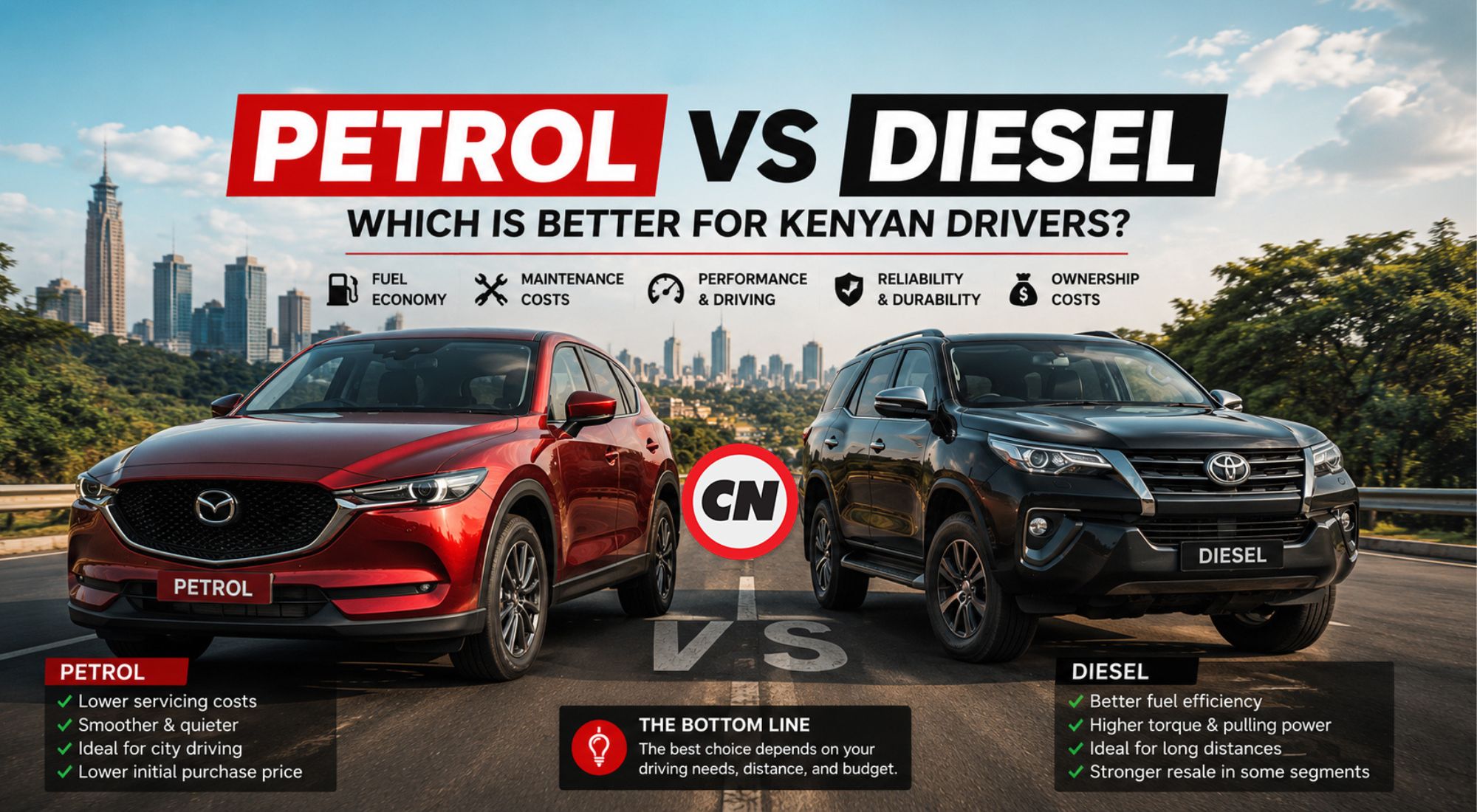
Petrol vs Diesel: Which Is Better for Kenyan Drivers?
In this guide, we'll compare petrol and diesel vehicles from a Kenyan perspective, examining fuel economy, maintenance, performance, reliability, resale value, and overall ownership costs.

CN Quick Facts
- Comparing petrol and diesel vehicles for Kenyan drivers.
- The engine you choose can affect fuel costs, maintenance expenses, resale value, and driving satisfaction for years.
- Fuel prices, road conditions, driving distances, and vehicle availability all influence whether petrol or diesel is the better choice in Kenya.
- Diesel generally suits high-mileage drivers and commercial users, while petrol often makes more sense for urban motorists and lower annual mileage.
So, Which Engine Is Better?
Choosing between a petrol and a diesel vehicle is one of the biggest decisions Kenyan car buyers face. Whether you’re shopping for a Toyota Prado, Mazda CX-5, Nissan X-Trail, Volkswagen Tiguan, or a pickup such as the Toyota Hilux, the engine type can significantly affect your fuel costs, maintenance expenses, driving experience, and long-term ownership costs.
What's in this Article
- So, Which Engine Is Better?
- What Is the Difference Between Petrol and Diesel Engines?
- Which Is More Fuel Efficient?
- Which Costs More to Maintain?
- Which Engine Lasts Longer?
- Which Is Better for City Driving?
- Which Is Better for Long-Distance Driving?
- Which Offers Better Performance?
- Which Is Better for Towing and Carrying Loads?
- How Do Petrol and Diesel Vehicles Compare Environmentally?
- Which Has Better Resale Value in Kenya?
- What About Fuel Availability in Kenya?
- Who Should Buy a Petrol Vehicle?
- Who Should Buy a Diesel Vehicle?
- Conclusion
For decades, diesel engines have been praised for their fuel efficiency and durability, while petrol engines have earned a reputation for refinement, lower maintenance costs, and smoother performance. However, advances in modern engine technology have blurred many of the traditional differences.
So, which option makes more sense for Kenyan motorists in 2026? The answer depends on how and where you drive.
In this guide, we’ll compare petrol and diesel vehicles from a Kenyan perspective, examining fuel economy, maintenance, performance, reliability, resale value, and overall ownership costs.
What Is the Difference Between Petrol and Diesel Engines?
Both petrol and diesel engines convert fuel into mechanical power, but they do so differently.
Petrol Engines
Petrol engines use spark plugs to ignite a mixture of air and fuel inside the cylinders.
They are typically:
- Quieter
- Smoother
- Faster-revving
- Less expensive to repair
Diesel Engines
Diesel engines ignite fuel using compression rather than spark plugs.
They are typically:
- More fuel-efficient
- Higher in torque
- Better for towing
- More durable under heavy workloads
CN Explained: What Is Torque?
Torque is the pulling power produced by an engine.
Higher torque helps a vehicle:
- Tow trailers
- Carry heavy loads
- Climb steep hills
- Accelerate with less effort
Diesel engines generally produce more torque than petrol engines.
Which Is More Fuel Efficient?
For most Kenyan motorists, fuel economy is the biggest factor.
Diesel Wins on Fuel Economy
Diesel engines extract more energy from each litre of fuel.
This means a diesel vehicle usually travels farther on the same amount of fuel.
Example
A diesel SUV may average:
12–15 km/L
while a similar petrol model may average:
8–11 km/L
The diesel vehicle uses significantly less fuel, which can translate into substantial savings for drivers covering long distances. Actual figures can vary based on several factors, including vehicle weight, driving style, traffic conditions, and maintenance.
Which Costs More to Maintain?
Petrol Vehicles
Petrol engines are generally simpler.
They usually have:
- Lower servicing costs
- Cheaper components
- Less complex emissions systems
Diesel Vehicles
Modern diesel engines often include:
- Turbochargers
- Diesel Particulate Filters (DPFs)
- High-pressure injectors
- Exhaust Gas Recirculation (EGR) systems
These components improve efficiency and emissions performance but can increase repair costs if neglected.
CN Insight
A well-maintained diesel vehicle can remain economical to own, but repairs tend to be more expensive when major components fail.
Which Engine Lasts Longer?
Diesel engines are traditionally known for durability.
Because they are designed to withstand higher compression forces, many diesel engines can cover exceptionally high mileage with proper maintenance.
It’s not uncommon for commercial diesel vehicles to exceed:
- 300,000 km
- 500,000 km
- Even 1 million km in some fleet applications
However, modern petrol engines have also become increasingly durable. Maintenance matters far more than fuel type.
Which Is Better for City Driving?
Petrol Wins
For motorists who spend most of their time:
- In Nairobi traffic
- On short daily commutes
- Running errands around town
Petrol vehicles often make more sense.
Reasons include:
- Faster engine warm-up
- Lower maintenance complexity
- Better suitability for short journeys
Which Is Better for Long-Distance Driving?
Diesel Wins
Diesel engines excel on:
- Highways
- Long-distance travel
- Commercial transport routes
Examples include:
- Nairobi to Mombasa
- Nairobi to Kisumu
- Nairobi to Eldoret
- Nairobi to Lodwar
- Nairobi to Meru
The combination of fuel efficiency and high torque makes diesel particularly attractive for long-distance motorists.
Which Offers Better Performance?
The answer depends on how you define performance.
Petrol Advantages
Petrol engines generally:
- Rev higher
- Feel more responsive
- Deliver smoother acceleration
Diesel Advantages
Diesel engines generally:
- Produce stronger low-speed torque
- Require fewer gear changes
- Feel more powerful under load
For sports cars, petrol usually wins.
For towing and utility work, diesel often has the advantage.
Which Is Better for Towing and Carrying Loads?
Diesel Is Usually the Better Choice
Diesel engines deliver maximum torque at lower engine speeds.
This makes them ideal for:
- Pickups
- SUVs
- Commercial vehicles
- Agricultural use
Popular examples in Kenya include:
- Toyota Hilux
- Isuzu D-Max
- Ford Ranger
- Mitsubishi L200
How Do Petrol and Diesel Vehicles Compare Environmentally?
Historically, diesel engines emitted less carbon dioxide (CO₂) because of their superior efficiency.
However, diesel engines also produce:
- Nitrogen oxides (NOx)
- Particulate matter (soot)
Modern emission-control technologies have significantly reduced these pollutants, but diesel systems require careful maintenance.
Petrol engines generally produce:
- Lower NOx emissions
- Less particulate matter
As Kenya gradually adopts hybrid and electric vehicles, both petrol and diesel engines face increasing environmental scrutiny.
Which Has Better Resale Value in Kenya?
Resale value depends heavily on:
- Brand reputation
- Vehicle condition
- Service history
- Market demand
Generally:
Diesel Models
Strong resale demand among:
- Fleet operators
- Commercial users
- Rural buyers
- Long-distance drivers
Petrol Models
Strong demand among:
- Urban motorists
- First-time buyers
- Family car shoppers
There is no universal winner.
What About Fuel Availability in Kenya?
Both petrol and diesel are widely available throughout Kenya.
However, diesel often remains the preferred fuel for:
- Trucks
- Buses
- Commercial fleets
As a result, diesel supply tends to be strong even in remote areas.
Who Should Buy a Petrol Vehicle?
A petrol vehicle may be the better choice if you:
- Primarily drive in cities
- Cover less than 20,000 km annually
- Want lower maintenance complexity
- Prefer smoother engine refinement
- Mostly take short trips
Who Should Buy a Diesel Vehicle?
A diesel vehicle may be the better choice if you:
- Cover high annual mileage
- Frequently travel long distances
- Tow trailers or heavy loads
- Drive SUVs and pickups
- Prioritise fuel economy
CN Key Takeaways
✔ Diesel engines offer superior fuel economy.
✔ Petrol engines typically have lower maintenance complexity.
✔ Diesel vehicles are ideal for long-distance drivers.
✔ Petrol vehicles are often better for urban commuting.
✔ Diesel engines produce more torque for towing and heavy loads.
✔ Maintenance history matters more than fuel type when buying a used vehicle.
✔ The best choice depends on your driving habits and ownership goals.
Conclusion
There is no single winner in the petrol versus diesel debate. The right choice depends on how you use your vehicle. If your driving consists mainly of urban commuting, shorter trips, and lower annual mileage, a petrol vehicle will often be the most practical and cost-effective option.
However, if you regularly cover long distances, tow loads, operate a business, or prioritise fuel economy, a diesel vehicle can deliver significant long-term savings and superior usability.
Before making a purchase, consider your annual mileage, fuel budget, maintenance expectations, and intended vehicle use. Choosing the right engine today can save you thousands of shillings over the life of your vehicle.
Continue Reading on CarNews KE
- Diesel Myths and Diesel Car Care: The Complete Guide
- Why Regular Car Servicing Saves You Money
- Buying a Car in Kenya on a Budget (2026 Guide)
- The True Cost of Car Ownership in Kenya
- Join the CarTalk KE Forum and Share Your Ownership Experience









No Comment! Be the first one.